Sustainable Agriculture in India
Introduction
Agriculture has always been the backbone of India’s economy, but today it faces new challenges such as, climate change, soil degradation, and rising food demand. To secure the future of farming, sustainable practices like drip irrigation, agroforestry, and regenerative agriculture are becoming essential. These innovations not only improve crop yields but also strengthen food security and protect natural resources.
Sustaining agricultural productivity depends on quality and availability of natural resources like soil and water. Agricultural growth can be sustained by promoting conservation and sustainable use of these scarce natural resources through appropriate location specific measures.
Key Practices
- Organic Farming: Eliminates chemical inputs, using compost, manure, and biofertilizers. Sikkim became India’s first 100% organic state in 2016, demonstrating profitability and environmental benefits.
- Crop Rotation and Diversification: Alternating crops reduces pest and disease risks, improves soil fertility, and minimizes chemical use.
- Agroforestry: Integrates trees with crops or livestock, enhancing biodiversity and soil conservation.
- Water Management: Techniques like drip irrigation and rainwater harvesting improve water use efficiency and reduce wastage.
- Precision Farming: Uses IoT, sensors, and AI to optimize inputs like water and fertilizers, improving yields and sustainability.
- Natural and Low-Input Farming: Practices such as mulching, intercropping, and integrated pest management reduce environmental impact
Government Initiatives
Indian agriculture remains predominantly rainfed covering about 60% of the country’s net sown area and accounts for 40% of the total food production. Thus, conservation of natural resources in conjunction with development of rainfed agriculture holds the key to meet rapidly growing demands for food grain in the country.
Towards this end, National Mission for Sustainable Agriculture (NMSA) has been formulated for enhancing agricultural productivity especially in rainfed areas focusing on integrated farming, water use efficiency, soil health management and synergizing resource conservation.
The National Mission for Sustainable Agriculture (NMSA) under the National Action Plan on Climate Change (NAPCC) is a central initiative promoting sustainable farming.
Key programs include:
- Rainfed Area Development (RAD) and On-Farm Water Management (OFWM) to improve productivity in rain-dependent regions.
- Soil Health Management (SHM) and Soil Health Card Scheme to monitor and enhance soil fertility.
- Paramparagat Krishi Vikas Yojana (PKVY) and Mission Organic Value Chain Development in North Eastern Region (MOVCDNER) to support organic farming clusters. As of 2024, MOVCDNER has supported over 189,000 farmers across 172,966 hectares, establishing collection, processing, and marketing infrastructure for organic produce.
- Per Drop More Crop (PDMC) for efficient irrigation and water conservation.
- National Bamboo Mission (NBM)and Clean Plant Programme (CPP) to promote sustainable horticulture and agroforestry.
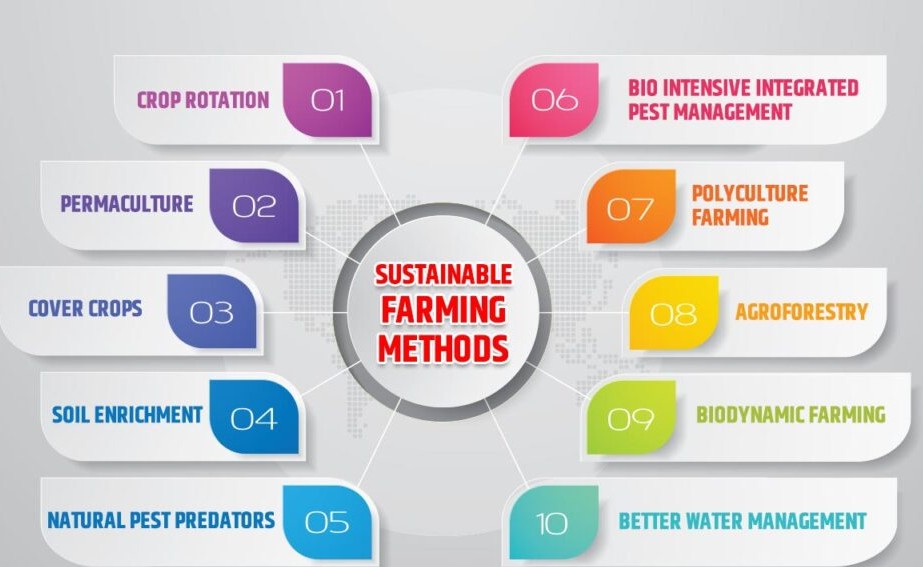
Thus, sustainable Agriculture in India:
- Focuses on eco-friendly farming practices that conserve natural resources, enhance soil health, and ensure long-term food security.
- Sustainable agriculture in India aims to produce food and fiber while protecting the environment, conserving water and soil, maintaining biodiversity, and supporting farmers’ livelihoods.
- Unlike conventional input-intensive farming, sustainable methods reduce reliance on synthetic fertilizers and pesticides, promote crop diversity, and optimize resource use to ensure that future generations can continue farming without compromising food security.
Adoption and Challenges
While sustainable agriculture is growing, it remains far from mainstream. Practices like crop rotation, agroforestry, and rainwater harvesting cover significant areas, but organic and natural farming are still limited to a small fraction of India’s net sown area.
Challenges include limited awareness, high initial costs, and the need for technical support and market access.
Benefits of Sustainable Agriculture
- Environmental: Reduces soil degradation, conserves water and mitigates climate change.
- Economic: Enhances farm productivity, reduces input costs, and improves farmers’ income.
- Social: Promotes food security, healthier produce, and community-based resource management.
- Sustainable agriculture in India represents a critical pathway for climate-resilient, resource-efficient, and socially inclusive farming, ensuring long-term productivity and environmental stewardship.
See Also…
ZERO BUDGET NATURAL FARMING
Indian Monsoon: At a Glance